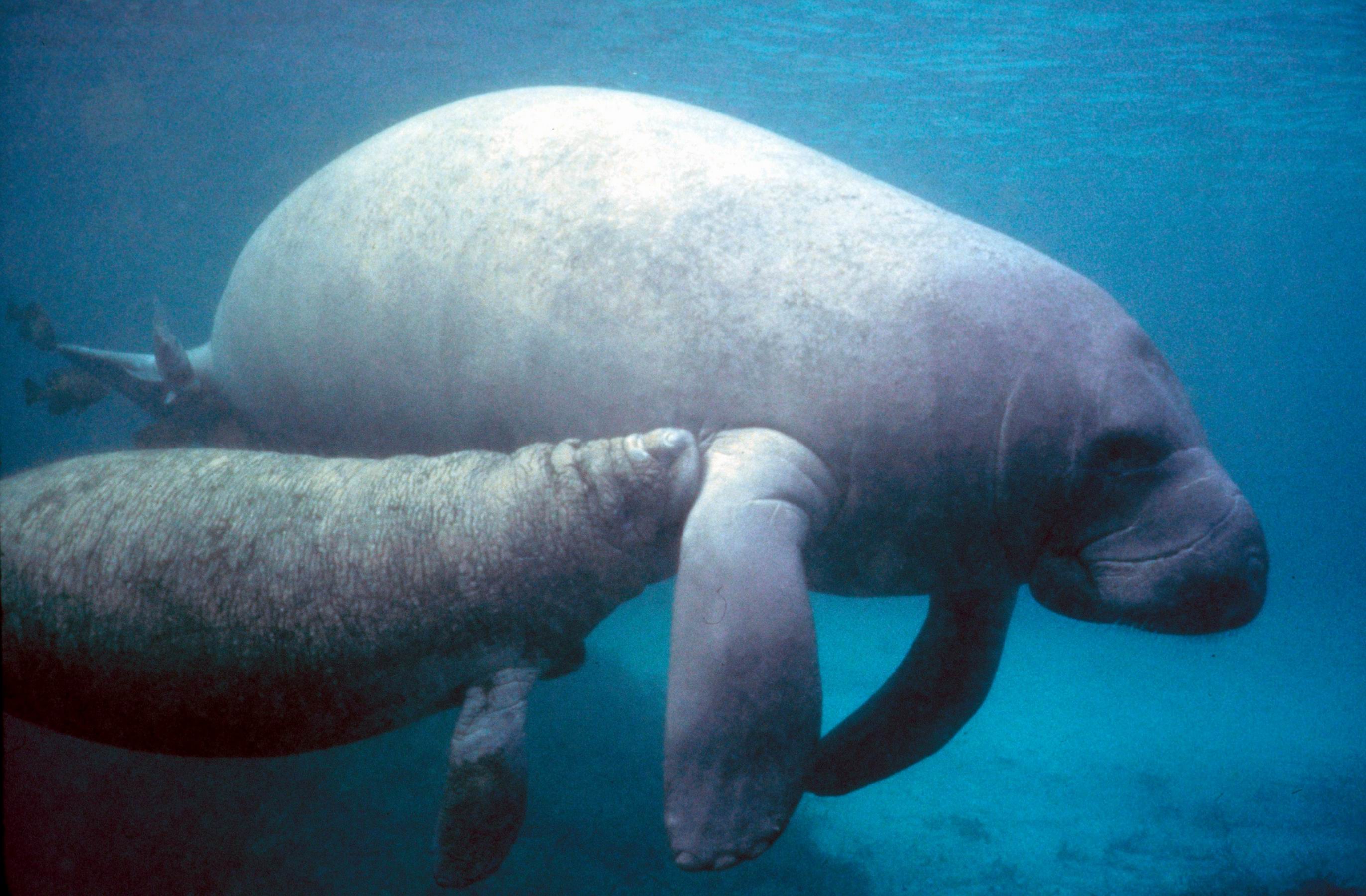
Gentle herbivorous "sea cows" that can eat up to 100 pounds of seagrass a day. Florida's state marine mammal.
§ Quick facts
§ Encyclopedia
The West Indian manatee, also known as the North American manatee, is a large, aquatic mammal native to warm coastal areas of the Caribbean, from the Eastern United States to northern Brazil. Living alone or in herds, it feeds on underwater plants and uses its whiskers to navigate. It is divided into two subspecies, the Florida manatee in the United States and the Antillean manatee in the Caribbean, both of which are endangered and face pressure from habitat loss, pollution, and other human activity. The West Indian manatee is the largest living member of the sirenians, a group of large aquatic mammals that includes the dugong, other manatees, and the extinct Steller's sea cow.
Source: Wikipedia — West Indian manatee Licensed under CC BY-SA 4.0
§ Identification
Field marks. Massive gray cigar-shaped marine mammal with paddle-like front flippers and broad rounded tail.
Similar species. Dugong (Indo-Pacific only). Beaver/Sea Otter (much smaller).
Voice. Squeaks, squeals, chirps for communication.
§ Diet & behavior
Diet. Aquatic plants — eelgrass, water hyacinth, seagrass, mangroves.
Behavior. Slow-moving gentle giants. Travels in small groups. Cannot tolerate temperatures below 68°F.
§ Range
Coastal waters and rivers from southeastern US through Caribbean
§ Habitat
Warm shallow estuaries, slow-moving rivers, springs, and seagrass beds
§ Threats
Boat strikes, cold-stress events, harmful algal blooms, seagrass die-offs from poor water quality.
§ Conservation status
According to the IUCN Red List, the west indian manatee is currently classified as Vulnerable.
§ What helps
Slow down in manatee zones. Reduce nutrient pollution. Support springs protection in Florida.
§ Further reading
- Wikipedia — West Indian manatee
- www.fws.gov — authoritative profile of Trichechus manatus
- IUCN Red List · taxon 22119
- iNaturalist · taxon 41773
- GBIF occurrence records
- Encyclopedia of Life — Trichechus manatus
§ Sources cited
- Save the Manatee Club
- USFWS
- FWC
- IUCN Red List 2008


