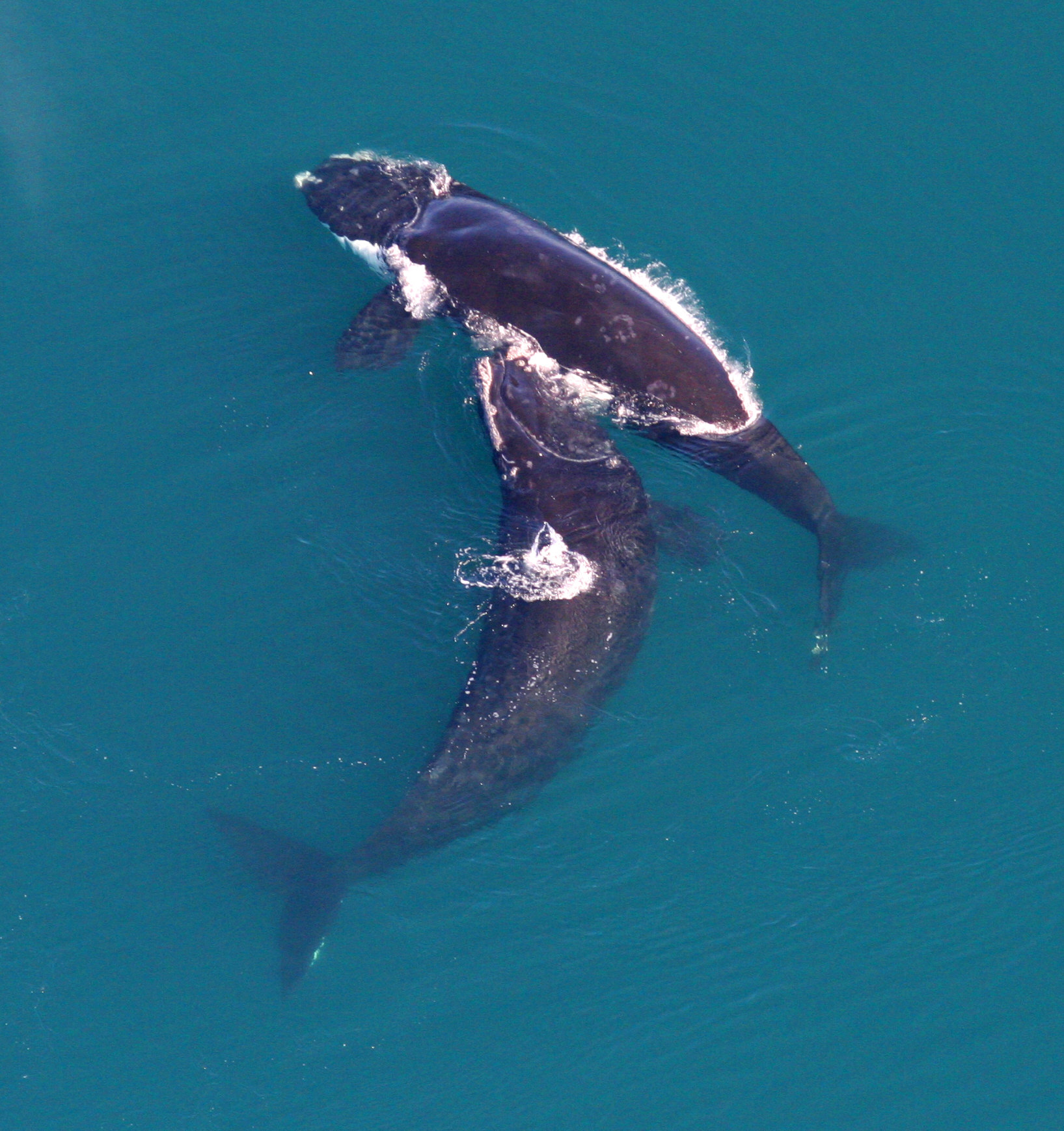
One of the rarest large whales on Earth — fewer than 360 individuals remain. Named "right" by 19th-century whalers because they were slow, floated when killed, and yielded the most oil. The legacy of that hunt is still unfolding.
§ Quick facts
§ Encyclopedia
The North Atlantic right whale is a baleen whale, one of three right whale species belonging to the genus Eubalaena, all of which were formerly classified as a single species. Because of their docile nature, their slow surface-skimming feeding behaviors, their tendencies to stay close to the coast, and their high blubber content, right whales were once a preferred target for whalers. At present, they are among the most endangered whales in the world, and they are protected under the U.S. Endangered Species Act and Marine Mammal Protection Act and Canada's Species at Risk Act. There are an estimated 356 individuals in existence in the western North Atlantic Ocean—they migrate between feeding grounds in the Labrador Sea and their winter calving areas off Georgia and Florida, an ocean area with heavy shipping traffic. In the eastern North Atlantic, on the other hand—with a total population reaching into the low teens at most—scientists believe that they may already be functionally extinct. Vessel strikes and entanglement in fixed fishing gear, which together account for nearly half of all North Atlantic right whale mortality since 1970, are their two greatest threats to recovery.
Source: Wikipedia — North Atlantic right whale Licensed under CC BY-SA 4.0
§ Identification
Field marks. Massive black whale with no dorsal fin; large head (~25% of body length) covered in pale callosities (rough patches of skin colonized by whale lice) used to identify individuals.
Similar species. Bowhead Whale (Arctic; bigger head, smoother skin). Other right whale species (North Pacific, southern). Gray Whale (mottled, has dorsal hump).
Voice. Low "up-calls" used for long-distance communication; moans and gunshot-like sounds.
§ Diet & behavior
Diet. Copepods and other zooplankton, filtered through baleen plates in coastal waters.
Behavior. One of the most endangered large whales — fewer than 360 individuals remain. Named "right whale" because whalers considered them the "right" whale to hunt (slow, coastal, floats when dead). Ship strikes and entanglement in fixed fishing gear are the two leading causes of death; calving rate has not kept pace with mortality since 2017.
§ Range
Atlantic coast from Florida to Nova Scotia
§ Habitat
Coastal and continental-shelf waters; calving grounds off Georgia and Florida
§ Threats
Vessel strikes (#1 threat), entanglement in fishing gear, ocean noise, climate-driven prey shifts to less protected waters.
§ Conservation status
According to the IUCN Red List, the north atlantic right whale is currently classified as Critically Endangered.
§ What helps
Support 10-knot vessel speed limits in seasonal management areas. Choose whale-safe seafood. Donate to disentanglement teams.
§ Further reading
- Wikipedia — North Atlantic right whale
- www.fisheries.noaa.gov — authoritative profile of Eubalaena glacialis
- IUCN Red List · taxon 41712
- iNaturalist · taxon 41468
- GBIF occurrence records
- Encyclopedia of Life — Eubalaena glacialis
§ Sources cited
- NOAA Fisheries North Atlantic Right Whale
- New England Aquarium
- Center for Coastal Studies
- IUCN Red List 2020


