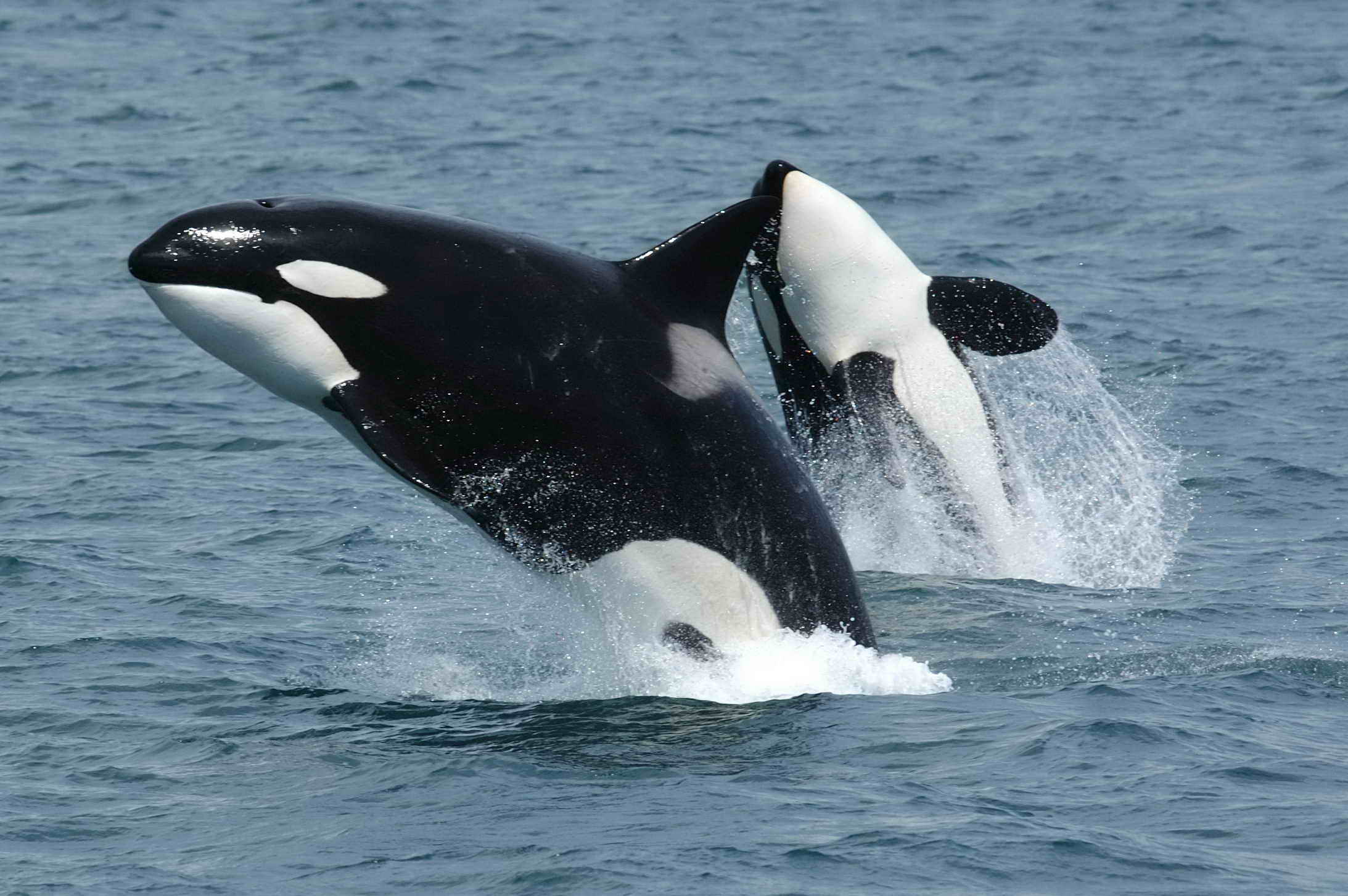
The ocean's apex predator and largest member of the dolphin family. Orcas live in matriarchal pods with distinct cultures — different populations have different prey preferences, dialects, and hunting techniques passed down through generations.
§ Quick facts
§ Encyclopedia
The orca, or killer whale, is a toothed whale and the largest member of the oceanic dolphin family. The only extant species in the genus Orcinus, it is recognizable by its distinct pigmentation; being mostly black on top, white on the bottom and having recognizable white eye patches. A cosmopolitan species, it inhabits a wide range of marine environments, from Arctic to Antarctic regions to tropical seas, but is more commonly documented in temperate or cooler coastal waters. Scientists have proposed dividing the global population into races, subspecies, or possibly even species.
Source: Wikipedia — Orca Licensed under CC BY-SA 4.0
§ Identification
Field marks. Unmistakable black-and-white pattern. Tall dorsal fin (1.8 m in males), white eye patch, gray "saddle" behind dorsal.
Similar species. No other cetacean looks similar in adult plumage. False Killer Whale (all dark, no white) is distantly related.
Voice. Complex repertoire of clicks, whistles, and pulsed calls; each pod has a unique "dialect."
§ Diet & behavior
Diet. Highly variable by population (ecotype): some specialize on fish (salmon eaters of the Pacific Northwest); others on marine mammals (seals, sea lions, even whales).
Behavior. Apex marine predator. Lives in stable matrilineal pods. Hunts cooperatively using techniques passed down generations: wave-washing seals off ice, beach-launching for sea lions.
§ Range
All oceans worldwide; resident populations off both US coasts
§ Habitat
Coastal and open ocean waters, with strong site fidelity to natal pods
§ Threats
Salmon decline (Southern Residents), boat noise disrupting echolocation, contaminants (PCBs persist in fat), entanglement.
§ Conservation status
According to the IUCN Red List, the killer whale (orca) is currently classified as Data Deficient.
§ What helps
Support salmon recovery in the Pacific Northwest. Choose tour operators that maintain 200+ yard distance. Reduce single-use plastics.
§ Further reading
- Wikipedia — Orca
- www.fisheries.noaa.gov — authoritative profile of Orcinus orca
- IUCN Red List · taxon 15421
- iNaturalist · taxon 41521
- GBIF occurrence records
- Encyclopedia of Life — Orcinus orca
§ Sources cited
- Center for Whale Research
- NOAA Fisheries SRKW
- Whale and Dolphin Conservation
- IUCN Red List 2017


