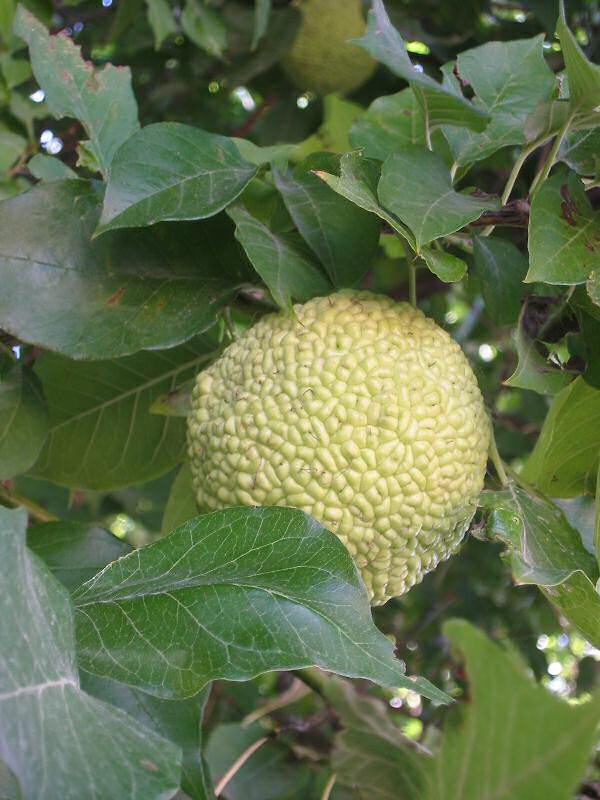
A small thorny tree producing large warty green "hedge apples" the size of softballs in fall. Wood is among the densest and hardest of any North American tree — historically used for bows by Osage tribes.
§ Quick facts
§ Encyclopedia
Maclura pomifera, commonly known as the Osage orange, is a small deciduous tree or large shrub, native to the south-central United States. It is a member of the mulberry family, Moraceae. It typically grows about 8 to 15 m (30–50 ft) tall. The distinctive multiple fruit resembles an immature orange, is roughly spherical, bumpy, 8 to 15 cm (3–6 in) in diameter, and turns bright yellow-green in the fall. The fruit excretes a sticky white latex when cut or damaged. Despite the name "Osage orange", it is not related to the orange.
Source: Wikipedia — Maclura pomifera Licensed under CC BY-SA 4.0
§ Identification
Field marks. Small to medium thorny tree; large warty greenish softball-sized fruits; shiny lance-shaped leaves.
Similar species. Distinctive in US.
§ Diet & behavior
Diet. N/A — photosynthesis
Behavior. Native to small region of TX/OK/AR; widely planted as hedgerows. Large warty fruits ("hedge apples") may have been dispersed by extinct megafauna; modern animals don't eat them.
§ Range
Native to small range in TX/OK/AR; widely planted
§ Habitat
Open fields, hedgerows, abandoned farms
§ Threats
Replacement of hedgerows with fence wire, lack of dispersers.
§ Conservation status
According to the IUCN Red List, the osage orange is currently classified as Least Concern.
§ What helps
Plant in hedgerows. Use thornless cultivars for ornamentals. Don't fear hedge apples (harmless if rotting).
§ Further reading
- Wikipedia — Maclura pomifera
- www.nwf.org — authoritative profile of Maclura pomifera
- iNaturalist · taxon 49163
- IUCN Red List — search for Maclura pomifera
- GBIF occurrence records
- Encyclopedia of Life — Maclura pomifera
§ Sources cited
- USDA Plants Database
- Pleistocene megafauna dispersal hypothesis


