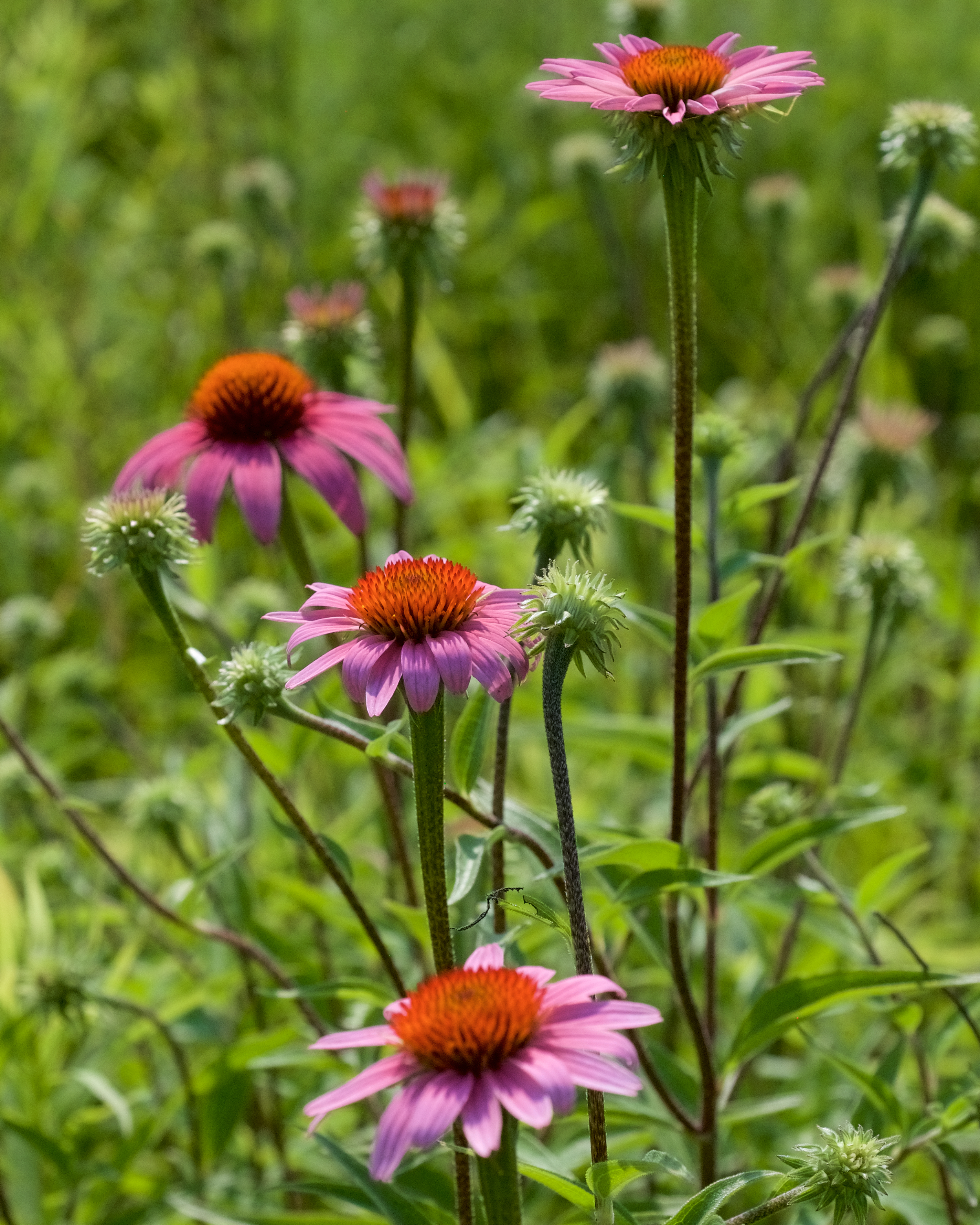
A native prairie wildflower whose purple-pink ray flowers and orange spiny center cones are pollinator magnets. Famous medicinally as Echinacea — used by indigenous peoples for centuries before European contact.
§ Quick facts
§ Encyclopedia
Echinacea purpurea, the eastern purple coneflower, purple coneflower, hedgehog coneflower, or Echinacea, is a North American species of flowering plant in the family Asteraceae. It is native to parts of eastern North America and present to some extent in the wild in much of the eastern, southeastern and midwestern United States, as well as in the Canadian Province of Ontario. It is most common in the Ozarks, the Mississippi Valley, and the Ohio Valley. Its habitats include dry open woods, prairies, and barrens.
Source: Wikipedia — Echinacea purpurea Licensed under CC BY-SA 4.0
§ Identification
Field marks. Tall plant with rough hairy leaves and large daisy-like flowers — pink-purple drooping ray florets surrounding a coppery-bronze conical spiny center.
Similar species. Pale Purple Coneflower (paler, narrower rays). Yellow Coneflower (yellow rays). Black-eyed Susan (yellow rays, dark center, no purple).
Voice. N/A
§ Diet & behavior
Diet. N/A — photosynthesis
Behavior. Native eastern prairie wildflower. Famous medicinally as Echinacea — used by indigenous peoples for centuries before European contact for wound healing, sore throats, and snakebite. Modern research supports some immune-modulating effects but evidence is mixed. Goldfinches, native bees, and many butterflies feed on the flowers and seeds.
§ Range
Eastern and central US, originally Great Plains
§ Habitat
Prairies, glades, meadows, open woods
§ Threats
Habitat loss, garden monocultures, deer browsing.
§ Conservation status
According to the IUCN Red List, the eastern purple coneflower is currently classified as Least Concern.
§ What helps
Plant native purple coneflower in sunny garden corners. Don't deadhead — leave seeds for finches. Support prairie restoration.
§ Further reading
- Wikipedia — Echinacea purpurea
- www.nwf.org — authoritative profile of Echinacea purpurea
- iNaturalist · taxon 51172
- IUCN Red List — search for Echinacea purpurea
- GBIF occurrence records
- Encyclopedia of Life — Echinacea purpurea
§ Sources cited
- USDA Plants Database
- Lady Bird Johnson Wildflower Center
- Xerces Society
- NIH National Center for Complementary and Integrative Health


