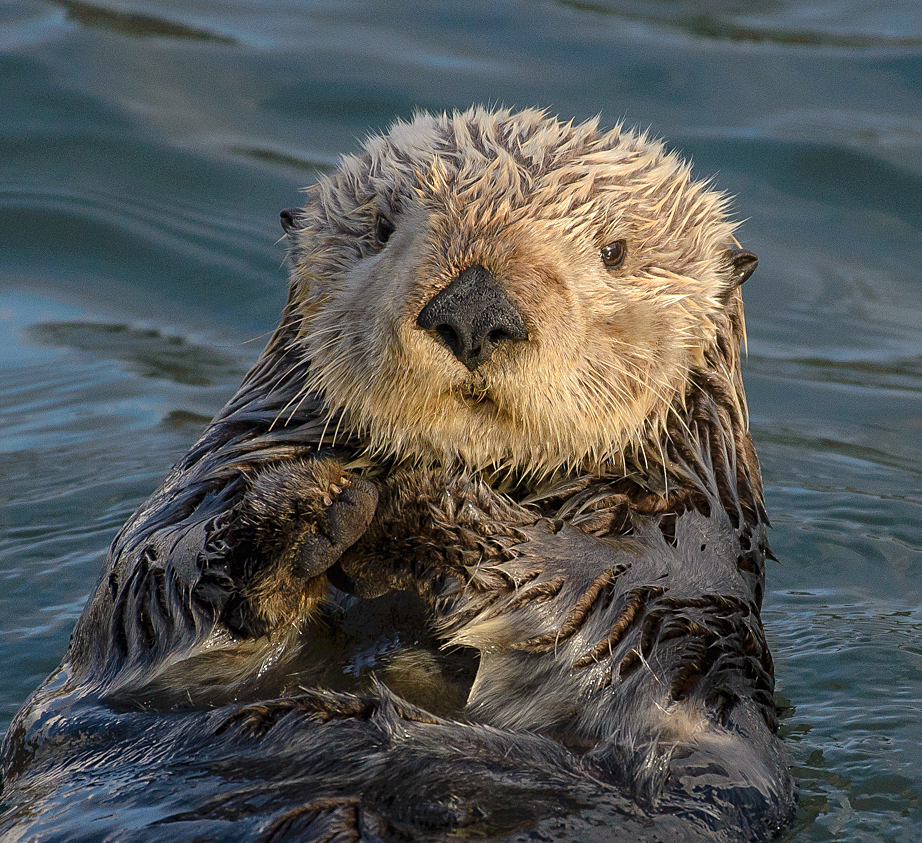
A keystone species whose love of sea urchins keeps kelp forests alive across the Pacific. They have the densest fur of any animal on Earth — up to a million hairs per square inch — used in lieu of blubber for warmth.
§ Quick facts
§ Encyclopedia
The sea otter is a marine mammal native to the coasts of the northern and eastern North Pacific Ocean. Adult sea otters typically weigh between 14 and 45 kg (30–100 lb), making them the heaviest members of the weasel family, but among the smallest marine mammals. Unlike most marine mammals, the sea otter's primary form of insulation is an exceptionally thick coat of fur, the densest in the animal kingdom. Although it can walk on land, the sea otter is capable of living exclusively in the ocean.
Source: Wikipedia — Sea otter Licensed under CC BY-SA 4.0
§ Identification
Field marks. Dark brown body with paler head; webbed hind feet; hand-like front paws. Floats belly-up at the surface, often with food on chest.
Similar species. River Otter (smaller, lighter brown, never floats belly-up). Harbor Seal (sleeker, no obvious limbs at rest).
Voice. Coos, squeals, screams, growls; pups produce piercing distress calls audible across kelp beds.
§ Diet & behavior
Diet. Sea urchins, abalone, crabs, clams, mussels, snails, sea stars. Uses stones as tools to crack hard prey — one of few mammals known to use tools.
Behavior. Spends nearly entire life in water, resting in floating "rafts" up to 100 individuals. Mothers carry pups on their chest. Densely furred (1 million hairs/in²) — the densest fur of any mammal.
§ Range
Coastal North Pacific from Alaska to California, with separate populations
§ Habitat
Nearshore kelp forests, rocky coastal waters
§ Threats
Oil spills, entanglement in fishing gear, disease outbreaks (toxoplasmosis from cat feces in runoff), climate-driven kelp loss.
§ Conservation status
According to the IUCN Red List, the sea otter is currently classified as Endangered.
§ What helps
Keep cat litter out of storm drains. Choose sustainably caught seafood. Donate to oil-spill response and kelp restoration.
§ Further reading
- Wikipedia — Sea otter
- www.fws.gov — authoritative profile of Enhydra lutris
- IUCN Red List · taxon 7750
- iNaturalist · taxon 41770
- GBIF occurrence records
- Encyclopedia of Life — Enhydra lutris
§ Sources cited
- Monterey Bay Aquarium
- USGS Western Ecological Research
- Friends of the Sea Otter
- IUCN Red List 2021


