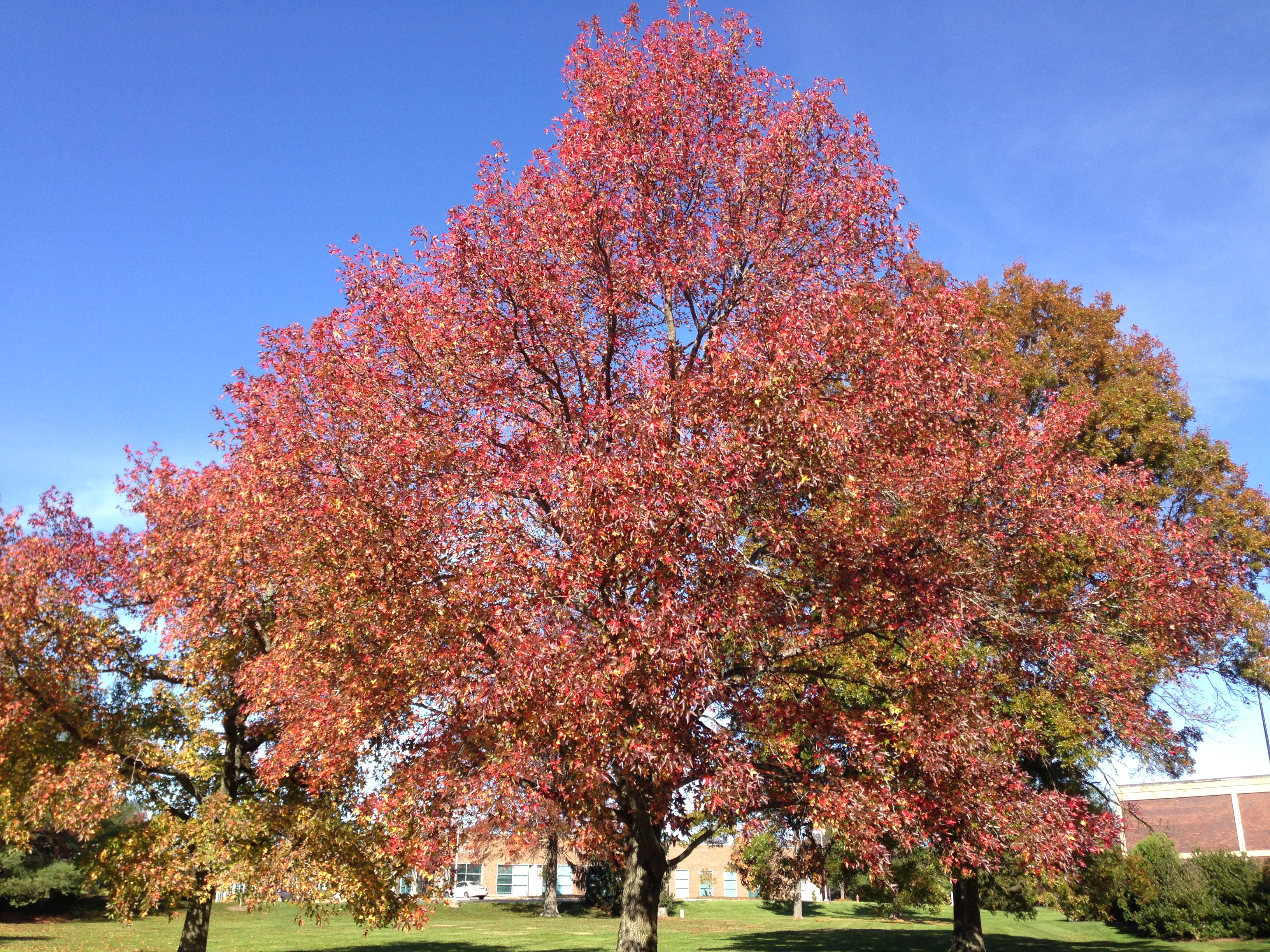
A medium-sized tree with star-shaped leaves and spiked "gumball" seed capsules that litter sidewalks (and toes) every autumn. Despite the litter problem, ecologically valuable for goldfinches and other seed-eaters.
§ Quick facts
§ Encyclopedia
Liquidambar styraciflua, commonly known as the American sweetgum among other names, is a deciduous tree in the genus Liquidambar native to warm temperate areas of eastern North America and tropical montane regions of Mexico and Central America. Sweetgum is one of the main valuable forest trees in the southeastern United States, and is a popular ornamental tree in temperate climates. It is recognizable by the combination of its five-pointed star-shaped leaves and its hard, spiked fruits. It is currently classified in the plant family Altingiaceae, but was formerly considered a member of the Hamamelidaceae.
Source: Wikipedia — Liquidambar styraciflua Licensed under CC BY-SA 4.0
§ Identification
Field marks. Medium-large tree with deeply lobed star-shaped leaves (5 points, occasionally 7); corky-winged twigs; spiky spherical fruit; gray furrowed bark.
Similar species. Red Maple (3-lobed leaves, smooth fruit). Sugar Maple (5-lobed but no points, no spiky fruit). Tulip Tree (4-lobed unique leaf).
Voice. N/A
§ Diet & behavior
Diet. N/A — photosynthesis
Behavior. Fast-growing native of bottomlands and recovering old fields. Five-lobed star-shaped leaves turn brilliant yellow, orange, red, and purple — often all colors on the same tree. Spiky "gumball" seed pods (woody fruits 2–4 cm across) persist into winter and litter sidewalks — making the species controversial in urban plantings despite its beauty.
§ Range
Eastern US (Connecticut to Texas)
§ Habitat
Bottomland forests, river edges, recovering old fields
§ Threats
Urban removal due to "messy" reputation, loss of bottomland forests.
§ Conservation status
According to the IUCN Red List, the american sweetgum is currently classified as Least Concern.
§ What helps
Tolerate gumball litter (or plant in less-trafficked yards). Don't remove from forests. Support bottomland protection.
§ Further reading
- Wikipedia — Liquidambar styraciflua
- www.nwf.org — authoritative profile of Liquidambar styraciflua
- IUCN Red List · taxon 194067
- iNaturalist · taxon 51924
- GBIF occurrence records
- Encyclopedia of Life — Liquidambar styraciflua
§ Sources cited
- USDA Plants Database
- USDA Forest Service Silvics Manual
- Morton Arboretum
- IUCN Red List 2018


