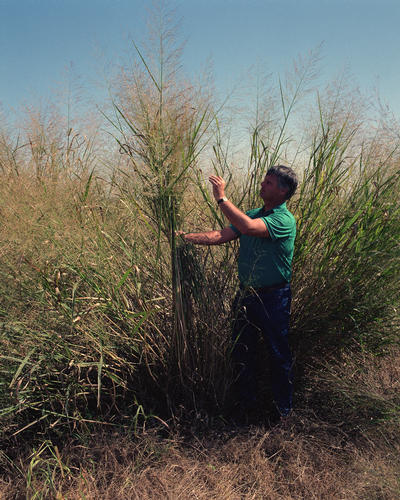
A keystone tallgrass prairie species — a clump-forming grass that grows 6+ feet tall and provides cover and seeds for grassland birds, small mammals, and pollinator nests.
§ Quick facts
§ Encyclopedia
Panicum virgatum, commonly known as switchgrass and panic grass, is a perennial warm season bunchgrass native to North America, where it occurs naturally from 55°N latitude in Canada southwards into the United States and Mexico. Switchgrass is one of the dominant species of the central North American tallgrass prairie and can be found in remnant prairies, in native grass pastures, and naturalized along roadsides. It is used primarily for soil conservation, forage production, game cover, as an ornamental grass, in phytoremediation projects, fiber, electricity, heat production, for biosequestration of atmospheric carbon dioxide, and more recently as a biomass crop for the production of ethanol and butanol.
Source: Wikipedia — Panicum virgatum Licensed under CC BY-SA 4.0
§ Identification
Field marks. Tall warm-season grass with open panicle of small flowers atop slender stems.
Similar species. Big Bluestem (different seed head). Indiangrass.
§ Diet & behavior
Diet. N/A — photosynthesis
Behavior. Native tallgrass prairie grass. Considered as a leading biofuel crop due to high biomass and drought tolerance.
§ Range
Throughout most of North America east of the Rockies
§ Habitat
Tallgrass prairies, dry meadows, restored grasslands
§ Threats
Conversion of native prairie to row crops, mowing during nesting season, pesticide drift.
§ Conservation status
According to the IUCN Red List, the switchgrass is currently classified as Least Concern.
§ What helps
Plant switchgrass in landscape and prairie restorations. Support prairie conservation. Delay mowing of grasslands until October.
§ Further reading
- Wikipedia — Panicum virgatum
- www.nwf.org — authoritative profile of Panicum virgatum
- iNaturalist · taxon 75942
- IUCN Red List — search for Panicum virgatum
- GBIF occurrence records
- Encyclopedia of Life — Panicum virgatum
§ Sources cited
- USDA Plants Database
- The Land Institute


