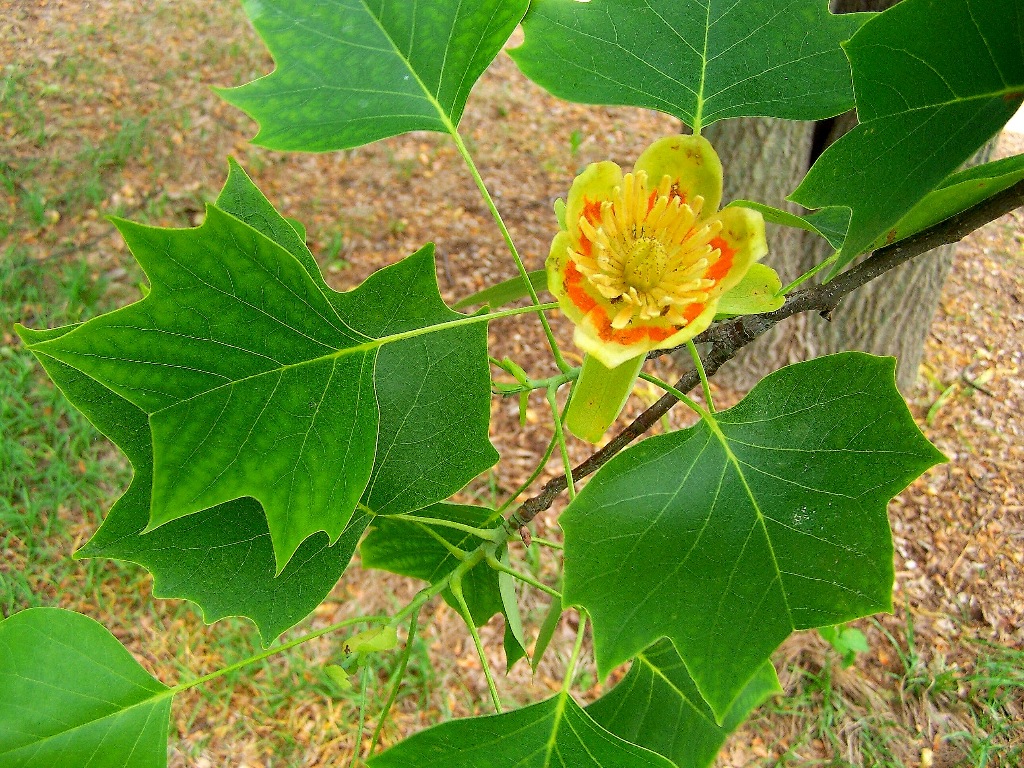
One of the tallest eastern hardwoods — verified specimens over 190 feet. The yellow-and-orange "tulip" flowers in spring are easily missed in the high canopy. State tree of Indiana, Kentucky, and Tennessee.
§ Quick facts
§ Encyclopedia
Liriodendron is a genus of two species of characteristically large trees, deciduous over most of their populations, in the magnolia family (Magnoliaceae).
Source: Wikipedia — Liriodendron Licensed under CC BY-SA 4.0
§ Identification
Field marks. Massive tree with unique 4-pointed leaves; tulip-shaped flowers; deeply furrowed bark.
Similar species. Distinctive in US. No similar species.
§ Diet & behavior
Diet. N/A — photosynthesis
Behavior. Among the tallest eastern hardwoods. State tree of Indiana, Kentucky, Tennessee. Highly valuable timber tree.
§ Range
Eastern US and Canada
§ Habitat
Mature deciduous forests on rich moist soils
§ Threats
Forest fragmentation, climate-driven range shifts, urban heat stress.
§ Conservation status
According to the IUCN Red List, the tulip tree is currently classified as Least Concern.
§ What helps
Plant tulip tree in yards with room (they get huge). Maintain mature forests. Support pollinator-friendly forests.
§ Further reading
- Wikipedia — Liriodendron
- www.nwf.org — authoritative profile of Liriodendron tulipifera
- iNaturalist · taxon 52853
- IUCN Red List — search for Liriodendron tulipifera
- GBIF occurrence records
- Encyclopedia of Life — Liriodendron tulipifera
§ Sources cited
- USDA Forest Service Silvics Manual


