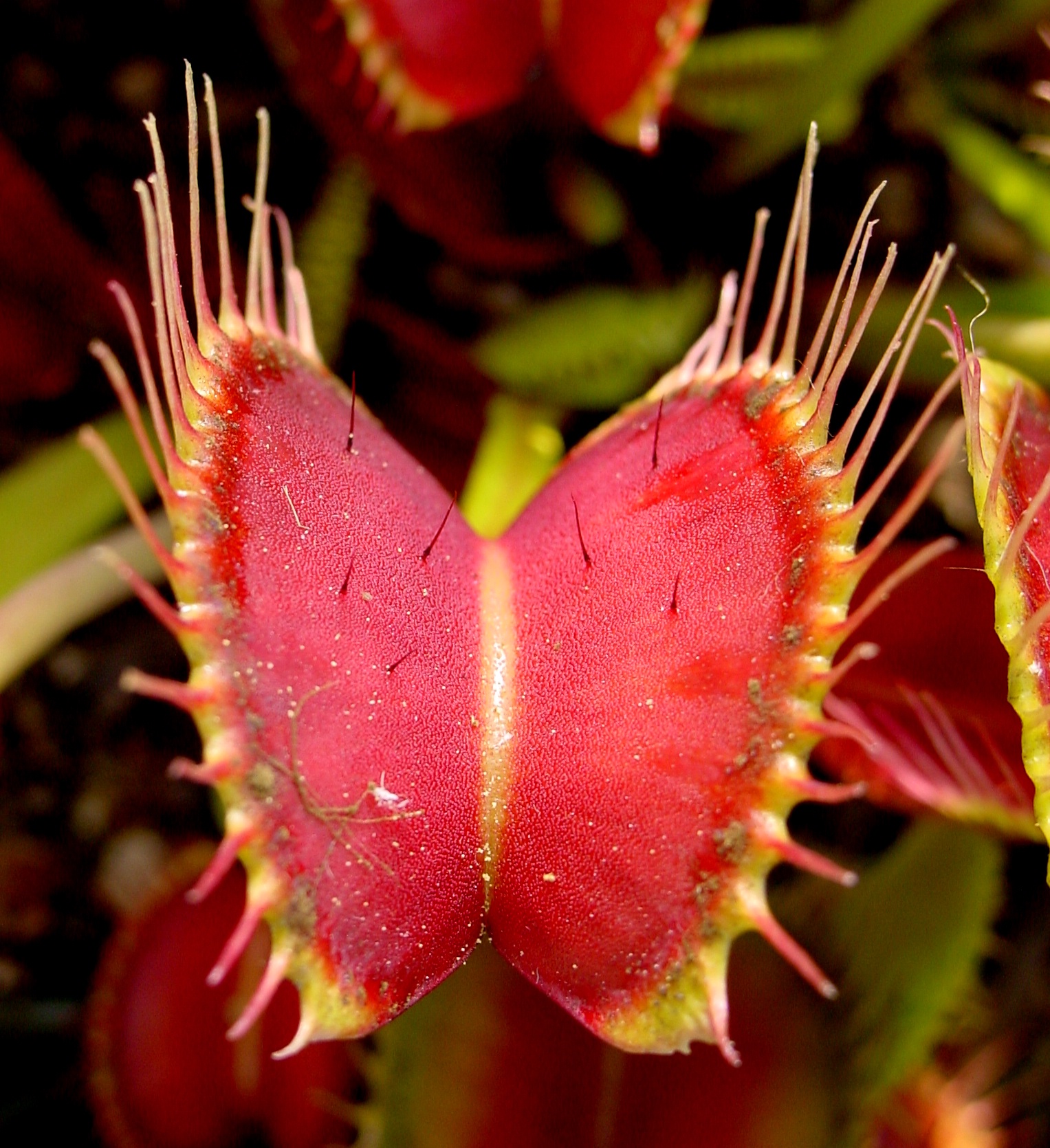
The carnivorous plant famous for snapping shut on insects. Native only to a small area of the Carolinas. Wild populations threatened by habitat loss and illegal collection.
§ Quick facts
§ Encyclopedia
The Venus flytrap is a carnivorous plant native to the temperate and subtropical wetlands of North Carolina and South Carolina, on the East Coast of the United States. Although various modern hybrids have been created in cultivation, D. muscipula is the only species of the monotypic genus Dionaea. It is closely related to the waterwheel plant and the cosmopolitan sundews (Drosera), all of which belong to the family Droseraceae. Dionaea catches its prey—chiefly insects and arachnids—with a "jaw"-like clamping structure, which is formed by the terminal portion of each of the plant's leaves; when an insect makes contact with the open leaves, vibrations from the prey's movements ultimately trigger the "jaws" to shut via tiny hairs on their inner surfaces. Additionally, when an insect or spider touches one of these hairs, the trap prepares to close, only fully enclosing the prey if a second hair is contacted within (approximately) twenty seconds of the first contact. Triggers may occur as quickly as 1⁄10 of a second from initial contact.
Source: Wikipedia — Venus flytrap Licensed under CC BY-SA 4.0
§ Identification
Field marks. Small rosette of bright green spoon-shaped leaves; each leaf tip modified as snap-trap with spiked edges.
Similar species. No other US plant is even close. Asian pitcher plants are unrelated.
Voice. N/A
§ Diet & behavior
Diet. Photosynthesis supplemented with insect prey. Each trap can capture 3–4 insects before becoming inactive.
Behavior. Trap shuts when 2 trigger hairs are stimulated within 30 seconds. Plant moves prey into the closed trap as it digests over 5–12 days.
§ Range
Coastal Carolinas (only natural range)
§ Habitat
Sandy pine savannas, ephemeral wet meadows
§ Threats
Habitat loss, illegal collection from wild, fire suppression.
§ Conservation status
According to the IUCN Red List, the venus flytrap is currently classified as Vulnerable.
§ What helps
Plant nursery-grown only. Don't collect from wild. Support Carolina coastal conservation.
§ Further reading
- Wikipedia — Venus flytrap
- www.fws.gov — authoritative profile of Dionaea muscipula
- IUCN Red List · taxon 39636
- iNaturalist · taxon 53074
- GBIF occurrence records
- Encyclopedia of Life — Dionaea muscipula
§ Sources cited
- North Carolina Botanical Garden
- USFWS
- The Nature Conservancy
- IUCN Red List 2020


